Choosing the right Sheet Bending machine can shape daily output, part quality, and future costs. A compact workshop may need a simple manual brake. A busy production floor may need CNC control, repeatable backgauging, and faster tool changes. The right choice depends on the work you actually run—not the most impressive specification sheet.
“[Insert a verified Sheet Bending expert’s name] says, ‘A machine should fit the part, the operator, and the production plan—not just the budget.’” Treat that as a sourcing placeholder, not a verified quotation. Before publishing, replace it with a confirmed expert and an accurate, attributable statement. Then assess your typical material thickness, bend length, alloy mix, and required angles. A machine that bends a thick sample once may struggle with that job across a full shift. Small differences matter.
Look closely at floor space, operator training, service access, tooling costs, and the support available after installation. Ask suppliers to demonstrate your own part, using your material where possible. Inspect the flange, angle consistency, and setup time. A polished demonstration is useful, but it is not a production test. Leave room for uncertainty: future orders can change, and operators may need time to master new controls. This guide explains the key machine types, specifications, and practical checks, helping you make a decision grounded in real work rather than guesswork.
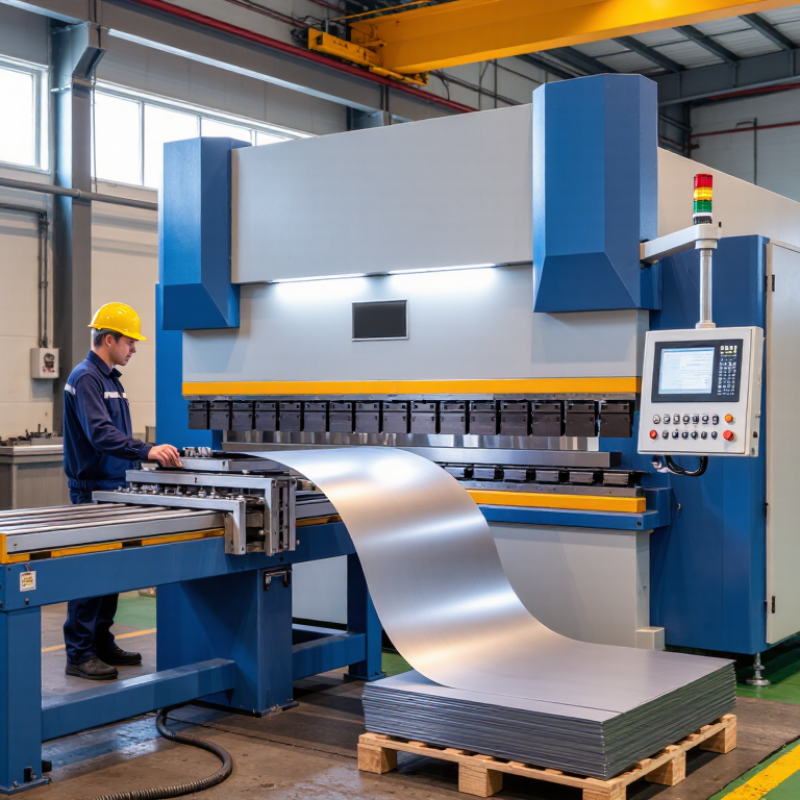
Define the Job Mix: Material, Thickness, Bend Length, and Annual Volume
A press brake should match the parts you actually make, not the largest part on a wish list. List your common materials, grades, thicknesses, bend lengths, and yearly quantities. World Steel Association’s World Steel in Figures 2024 reports 1,892.2 million tonnes of crude steel production in 2023. That figure shows steel’s scale, but it cannot tell you the forming force for your specific grade. Check material strength, then calculate tonnage for the thickest regular job. Do not size the machine around mild steel if stainless steel appears often.
Measure bend length carefully. A 2.5-meter panel needs different tooling support and machine capacity from a short bracket, even when both use the same sheet thickness. Record flange sizes, bend angles, and whether parts need multiple setups. Small details matter. A mixed shop may value quick tooling changes more than maximum tonnage. Annual volume changes the calculation, too: frequent repeat batches can justify automated backgauges, while varied low-volume work may need flexible setup features. Compare expected cycle time with realistic loading and inspection time, not ideal catalog speed.
Build a simple job table from recent orders: material, thickness, longest bend, and annual parts. Include occasional jobs, but mark them clearly. A spreadsheet can still miss future work; that is worth admitting. Ask operators to review the list, then have a qualified supplier verify tonnage and tooling against the actual part drawings.
Choose V-Die Width at About 6–8× Sheet Thickness for Air Bending
For air bending, a practical starting point is a V-die opening about 6–8 times the sheet thickness. For 1.5 mm mild steel, that means a 9–12 mm opening. Common press-brake setup charts use this range because the opening affects bend radius, force, and the risk of marking the sheet. ASM Handbook, Volume 14B: Metalworking: Sheet Forming, also emphasizes that forming results depend on material and tooling conditions. The rule is useful, but it is not magic.
With mild steel, a common shop estimate puts the inside radius near 0.16 times the V opening. A 10 mm die opening may therefore produce a radius around 1.6 mm. Actual results shift with tensile strength, temper, grain direction, and bend angle. Check the machine’s tonnage chart before loading the job; a die that is too narrow can demand more force and may overload the setup. A quick test bend on offcut material is worth the minute.
Tips: Measure the actual sheet thickness, not just its nominal gauge. Start near 6× thickness for tighter bends, then test. Move toward 8× when the material is stronger or surface marking is a concern. Record the opening, angle, and measured radius for repeat jobs.
Estimate Bend Allowance with a K-Factor Starting Range of 0.3–0.5
How to Choose the Right Sheet Bending Machine for Your Business?
Estimate Bend Allowance with a K-Factor Starting Range of 0.3–0.5
A sheet bending machine is only as accurate as its setup data. Estimate bend allowance before comparing machine capacity, tooling, and repeatability. Use K = 0.3–0.5 as a starting range, not a fixed rule. Bend allowance = bend angle in radians × (inside radius + K × material thickness). This neutral-axis method is covered in ASM Handbook, Volume 14B, Metalworking: Sheet Forming.
For 1.5-mm mild steel, a 90-degree bend, and a 1.5-mm inside radius, K = 0.4 gives an allowance of about 3.30 mm. Small shifts matter: changing K by 0.1 alters the allowance by about 0.24 mm. Test coupons using the actual material, grain direction, punch radius, and die opening. ISO 7438:2020 describes a standardized bend-test method for metallic materials, but production settings still need verification on your equipment.
Tips: Cut three coupons. Measure each flange after bending, then adjust K in your software or setup sheet. Record the material batch and tooling. The estimate may still be off; that is useful feedback, not a reason to trust the first number blindly.
How to Choose the Right Sheet Bending Machine for Your Business? - Estimate Bend Allowance with a K-Factor Starting Range of 0.3–0.5
| Machine Type |
Best Suited For |
Typical Work Range |
Key Selection Checks |
K-Factor Starting Range |
| Manual folding machine |
Prototypes, repair work, and low-volume production with straightforward bends. |
Thin sheet and shorter parts; verify the machine’s rated capacity for the material and full working length. |
Check maximum material thickness, bending length, clamping arrangement, and whether the required bend angles can be repeated consistently. |
0.30–0.50 |
| Hydraulic press brake |
General fabrication, varied part sizes, and regular production across a range of materials. |
Available in a wide range of capacities and bed lengths; select tonnage using material type, thickness, bend length, tooling, and die opening. |
Confirm required force and working length, tooling compatibility, backgauge needs, and available floor space. |
0.30–0.50 |
| CNC press brake |
Repeat production, multi-bend parts, and jobs requiring consistent angle and positioning control. |
Capacity depends on the selected model; match the rated force and bending length to the largest planned job. |
Assess control axes, backgauge configuration, programming requirements, operator training, and setup time for typical jobs. |
0.30–0.50 |
| Panel bender |
High-volume production of panels and repeatable box-like parts. |
Part dimensions and material limits are model-specific; check flange geometry and the machine’s permitted blank size. |
Compare expected production volume, part family, automation needs, changeover time, and compatibility with existing processes. |
0.30–0.50 |
Illustrative Bend Allowance Estimates
| Bend Angle |
Sheet Thickness (T) |
Inside Radius (R) |
K-Factor Range |
Estimated Bend Allowance |
| 90° |
2.0 mm |
2.0 mm |
0.30–0.50 |
4.08–4.71 mm |
| 90° |
3.0 mm |
3.0 mm |
0.30–0.50 |
6.13–7.07 mm |
| 90° |
1.5 mm |
1.5 mm |
0.30–0.50 |
3.06–3.53 mm |
Bend allowance is estimated using BA = θ × (R + K × T), where θ is the bend angle in radians, R is the inside bend radius, T is the sheet thickness, and K is the K-factor. These figures are starting estimates; actual values depend on material, tooling, and bending method. Validate them with test bends before finalizing flat-pattern dimensions.
Compare CNC Axes, Backgauge Options, and Repeatability Specifications
Choosing a sheet bending machine starts with the parts you actually make.
List their flange lengths, material thicknesses, and bend sequences. A machine with extra CNC axes may save setup time, but unused motion adds cost and complexity. The Y-axis controls ram position; X moves the backgauge. R-axis height adjustment helps support varied flange sizes, while Z-axis movement can position multiple fingers across the bed.
Match axes to real jobs, not a feature list.
Backgauge options matter when parts have short flanges, changing widths, or several bends. Check finger spacing, adjustment range, and whether the stops can clear the workpiece between bends.
A simple setup may suit repeat batches. More flexible positioning helps with mixed production.
Small parts expose drift. Ask to bend sample parts similar to yours, then inspect whether they sit square against the stops.
Repeatability is not the same as accuracy. A machine can make the same bend consistently and still need a small angle correction for a new material batch. Review the stated repeatability figures, but also ask how they were measured and under what conditions. Run several cycles with the same setup, then measure angles and flange dimensions. Record the results.
Real shop conditions vary, and a neat demonstration may not reveal every setup issue. A little uncertainty is worth discussing before purchase.
Verify Machine Safeguards Against EN 12622 Press-Brake Safety Requirements
When comparing sheet bending machines, treat safeguarding as a buying criterion, not an accessory.
Ask for evidence that the hydraulic press brake’s safety functions have been assessed against the applicable edition of EN 12622. The standard addresses hazards such as crushing at the tooling area. A short sales demonstration is not enough.
Inspect the actual setup. Depending on the machine and operating mode, safeguards may include presence-sensing devices, interlocked guards, or two-hand controls. Ask how the chosen system protects the operator during normal bending, tool changes, and setup. Request stopping-time measurements and confirmation that safety distances match the installed equipment. Check that control modes cannot be changed casually, and that faults trigger a safe response. Small details matter.
Look beyond the hardware.
Review the risk assessment, operating instructions, inspection schedule, and records of safety-function validation. Have a competent person verify the machine after installation and whenever tooling or safeguards change. Ask who handles training and periodic checks. A neat checklist can still miss awkward jobs, like handling a long, flexible sheet that blocks the operator’s view. That gap deserves a real discussion before purchase. Also confirm which requirements apply at your site; a machine’s declaration alone does not prove safe use in every workplace.
Conclusion
Choosing the right Sheet Bending machine starts with a clear picture of the work it will handle. Consider the materials you process, their thickness, the maximum bend length, and your expected annual production volume. These factors help determine the machine’s capacity and whether a manual, hydraulic, or CNC-controlled setup best fits your workflow. For air bending, a V-die opening around six to eight times the sheet thickness is a useful starting point, though material properties and bend requirements may call for adjustments. When estimating bend allowance, begin with a K-factor in the 0.3–0.5 range and refine it through calculations or test bends.
Compare available CNC axes and backgauge options according to the complexity of your parts and the repeatability your production requires. Review the machine’s specifications alongside practical demonstrations where possible. Finally, verify that its safeguards and operating procedures align with the applicable EN 12622 press-brake safety requirements, and ensure operators receive appropriate training.

 Hongrui Model