Choosing a 5 Axis Machining manufacturer in China involves more than comparing machine counts or quoted prices. A capable supplier must translate a drawing into a stable process, hold demanding tolerances, and communicate clearly when a design needs adjustment. China’s manufacturing base includes companies serving aerospace, medical, automotive, and industrial customers, but their equipment, experience, and quality systems can differ widely. A polished website alone is not proof.
This guide introduces five manufacturers and explains what buyers should examine before requesting a quotation. The comparison considers machining capabilities, materials, inspection practices, communication, and production support. For a real evaluation, ask about similar completed parts, not just impressive sample pieces. A machined aluminum housing may look clean on a desk, while its bore alignment, surface finish, and inspection records tell a fuller story. Ask how the supplier handles tool access, fixture design, and changes between prototype and production runs. Request relevant quality documents and confirm that measurement methods match the drawing’s requirements. Details matter.
No shortlist can represent every buyer’s needs, and rankings may change as facilities and services evolve. That deserves attention. A supplier suited to a complex impeller may not be the right choice for a repeat run of simpler brackets. Treat this overview as a starting point, then verify claims directly with each company. Clear questions, sample documentation, and a realistic review of lead times can reveal strengths that marketing language leaves out. The best fit is not always the largest shop. It is the one that can explain its process, show relevant evidence, and deliver consistently.
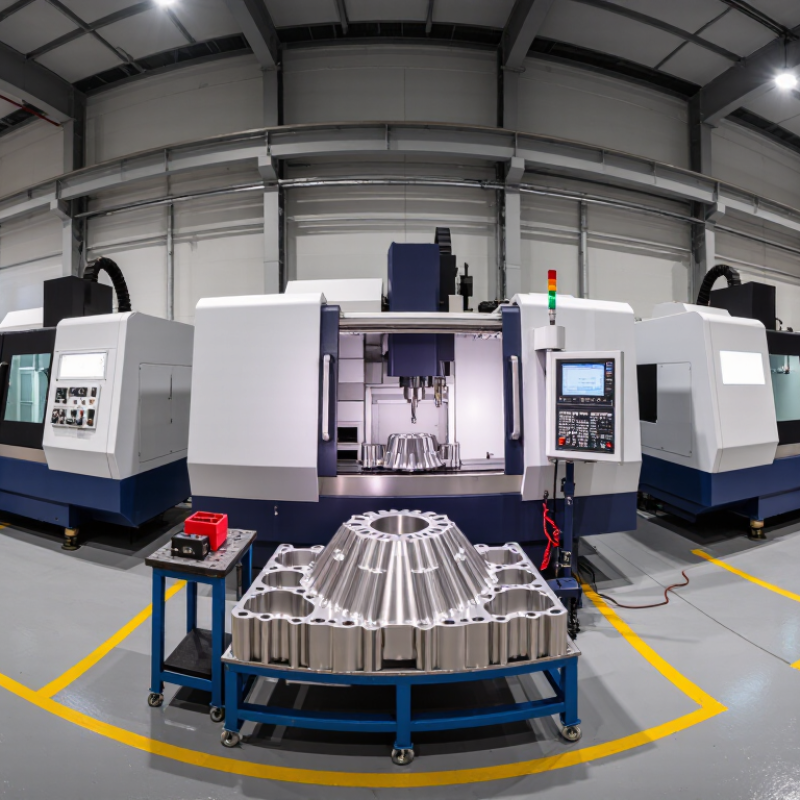
Five-axis machining moves a cutting tool along three linear axes—X, Y, and Z—while rotating the workpiece, tool, or both around two additional axes. These rotary movements let the cutter approach a part from changing angles. The machine can reach several faces without repeated manual repositioning. Fewer setups can reduce alignment errors, though they do not remove them entirely.
A programmer uses CAD and CAM software to plan toolpaths, select cutting tools, and check how the tool meets the material. During cutting, the machine coordinates its axes to maintain the programmed direction and position. This is useful for parts with curved surfaces, deep cavities, angled holes, or blades. A small rotary-table error can still affect a tight feature. Details matter.
Five-axis work is not automatically faster or more accurate. A skilled team must consider machine limits, tool length, material, fixtures, and the risk of collision. Simulation helps reveal problems before cutting, but real machining can differ because of tool wear or setup variation. The first setup is rarely perfect. That is worth reviewing. For buyers comparing machining manufacturers, ask how they verify toolpaths, manage tolerances, and inspect finished parts.
It moves a cutting tool along three linear axes and rotates the tool, workpiece, or both around two more axes. The cutter can reach several faces from changing angles.
It suits parts with curved surfaces, deep cavities, angled holes, or blades. Examples include turbine blades, aircraft brackets, motor housings, and precision molds.
No. Fewer setups can reduce alignment errors, but machine limits, fixtures, tool wear, and setup variation still affect results. Not automatically.
Programmers use CAD and CAM software to plan toolpaths, choose cutters, and check tool contact. Simulation can reveal collision risks, though real cutting may differ.
Review sample-part accuracy, inspection methods, and records for angled features. Ask how the shop measures a tilted surface. Details matter.
Aerospace, automotive, medical-device, energy, and industrial-equipment sectors use it. Materials and inspection needs vary by application.
Ask how it controls heat distortion in aluminum and tool wear in titanium. Request process records and inspection reports, not only a polished brochure.
No. Global electric-car sales reached nearly 14 million in 2023, but supplier orders depend on capacity, certifications, and delivery performance. Figures alone prove little.
This article explains how 5 Axis Machining works, showing how coordinated movement across multiple axes can produce complex shapes, precise features, and fewer setups than conventional machining. It also outlines practical criteria for comparing manufacturers in China, including equipment capabilities, engineering experience, quality-control processes, material options, production capacity, communication, and delivery reliability.
The article profiles five leading manufacturers without focusing on brand names, and reviews the industries and applications they serve, from aerospace and automotive components to medical devices, electronics, and industrial equipment. It concludes with guidance for selecting a suitable manufacturing partner: define the part’s requirements, assess technical and inspection capabilities, request relevant project examples, and compare quotations alongside lead times and service. Careful evaluation can help buyers find a supplier that balances precision, consistency, cost, and dependable collaboration.

 Hongrui Model