In 2026, Cnc Machining remains central to aerospace, medical, automotive, energy, and precision engineering. Yet identifying the “top” companies requires more than counting machines or listing famous names. Strong candidates combine tight tolerances, certified quality systems, skilled operators, reliable delivery, and transparent communication. Their workshops may contain five-axis mills, automated inspection cells, and lights-out production lines. The equipment matters. The people matter more.
Peter Zelinski, an experienced manufacturing journalist and editor at Modern Machine Shop, has expressed a practical industry principle: “Automation is not just about replacing labor; it is about making better use of people.” This idea shapes our comparison. Leading companies use automation to improve consistency, reduce handling errors, and support complex production. They do not treat technology as a shortcut around engineering judgment. That distinction is easy to overlook.
This overview examines companies through measurable signals, including material capability, machining accuracy, inspection methods, prototyping support, production capacity, and customer-sector experience. It also considers less visible factors, such as engineering communication and corrective-action discipline. A polished website proves very little. Real performance appears in repeatability, documentation, and delivered parts.
There is no perfect ranking.
Company strengths change by project. A supplier suited to titanium aerospace brackets may not fit urgent medical prototypes or high-volume aluminum components. Some information is also difficult to verify publicly. Therefore, this guide should be read as a practical starting point, not an unquestionable verdict. The final decision still requires drawings, specifications, sample parts, audits, and direct technical discussion.
What Are the Top CNC Machining Companies in 2026?
Top CNC machining companies in 2026 should be measured through revenue, capacity, and verified certifications. Revenue indicates market reach and financial stability. It does not prove consistent machining quality. A large sales figure may include subcontracted work, trading activity, or unrelated services. Buyers should examine annual revenue alongside repeat orders, delivery performance, and workforce experience. These details reveal whether growth is supported by real production capability.
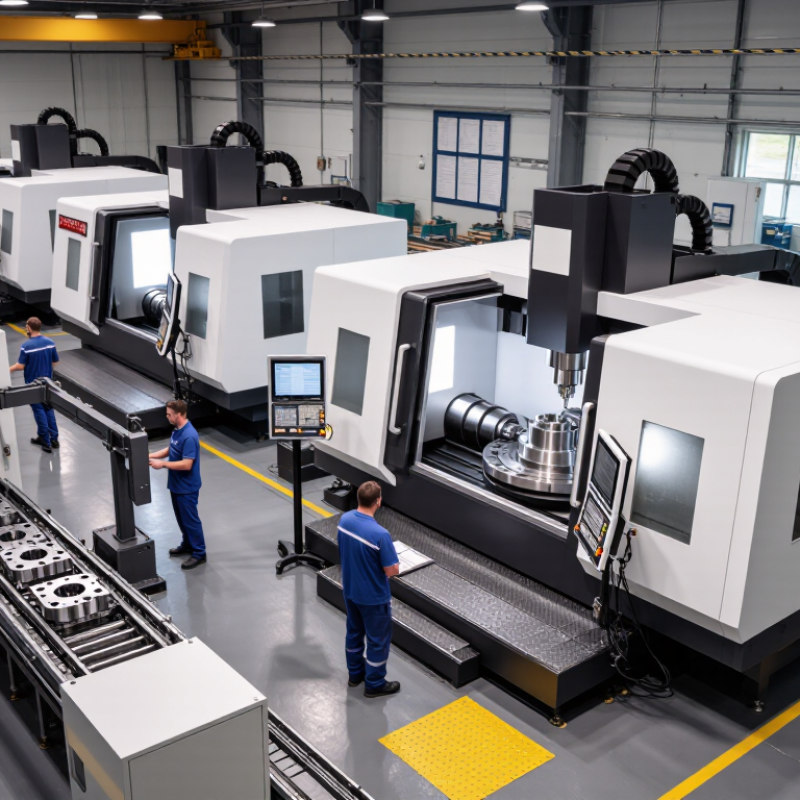
Capacity requires more than counting machines. Strong manufacturers may operate five-axis mills, turning centers, automated pallet systems, and inspection equipment. Their facilities should show practical throughput, not unused assets. Ask about machine envelope, tolerance control, material experience, and monthly production volume. A shop producing small aluminum parts may not handle heavy steel components efficiently. Details matter.
Certifications provide a useful quality framework. ISO 9001 supports documented process control, while AS9100 or ISO 13485 may suit aerospace or medical work. However, a certificate alone cannot guarantee accurate parts. Reliable companies connect certification with calibration records, first article inspection, traceability, and corrective-action reports. Audits should confirm daily behavior. Public information is sometimes incomplete, which makes rankings imperfect. That weakness deserves attention. Buyers should request current certificates, sample inspection reports, and realistic lead-time data before selecting a long-term machining partner.
| Benchmark Category | Annual Revenue Band | Typical Production Capacity | Machining Scope | Common Certifications | Typical Industries Served | Public Disclosure Level |
|---|---|---|---|---|---|---|
| Global diversified machining group | Above US$1 billion | Multi-site; more than 1,000 CNC machines across regional facilities | CNC milling, turning, grinding, Swiss-type machining, sheet metal, assembly and finishing | ISO 9001; ISO 14001; ISO 45001; IATF 16949; AS9100 at qualified aerospace sites | Automotive, aerospace, medical, industrial automation and energy | High; audited financial and certification information is generally available |
| Large contract manufacturer | US$250 million–US$1 billion | Several hundred CNC machines; high-volume, multi-shift production | Three-, four- and five-axis machining; turning; inspection; surface treatment and assembly | ISO 9001; ISO 13485 for medical work; IATF 16949 for automotive programs; AS9100 where applicable | Automotive, medical devices, aerospace components and consumer equipment | Medium to high; customer and facility data are often disclosed selectively |
| Specialized aerospace and defense supplier | US$100 million–US$500 million | 50–300 advanced CNC machines with dedicated inspection and traceability systems | Five-axis machining, complex titanium and nickel-alloy parts, tight-tolerance inspection and low-volume production | AS9100; ISO 9001; NADCAP accreditation for applicable special processes; ITAR controls where required | Commercial aerospace, defense, space systems and propulsion | Medium; contract restrictions can limit revenue and customer disclosure |
| Medical and precision-engineering specialist | US$50 million–US$250 million | 20–150 CNC machines focused on repeatable, documented precision production | Micro-machining, Swiss turning, five-axis milling, electropolishing, cleanroom-compatible assembly and metrology | ISO 13485; ISO 9001; FDA quality-system compliance where applicable; ISO 14971 support for relevant products | Medical devices, surgical instruments, diagnostics and precision electronics | Medium; certification scope is usually clearer than financial scale |
| Regional high-mix, low-volume manufacturer | US$10 million–US$100 million | 10–75 CNC machines; flexible scheduling for prototypes and production batches | CNC milling, turning, rapid prototyping, fixture production and secondary operations | ISO 9001 is common; AS9100, ISO 13485 or IATF 16949 may apply to certified market segments | Industrial machinery, robotics, electronics, automotive and general engineering | Low to medium; private-company financial data is often unavailable |
| Digital-first on-demand machining network | US$10 million–US$500 million, depending on platform and operating model | Distributed capacity through qualified partner facilities rather than one centralized plant | CNC milling, turning, sheet metal, additive manufacturing, finishing and rapid quotation | ISO 9001 or equivalent supplier controls; additional AS9100, ISO 13485 or IATF 16949 coverage depends on the facility | Product development, electronics, robotics, automotive, aerospace and industrial design | Variable; platform revenue and supplier capacity may not be directly comparable |
Note: Revenue bands and capacity figures are industry benchmark ranges for anonymous company profiles, not claims about any named company. Certification requirements vary by facility, product, market and customer contract. ISO 9001, ISO 13485, IATF 16949 and AS9100 are internationally recognized management-system standards used in the listed sectors.
Compare revenue, verified capacity, delivery history, certifications, and repeat orders. Revenue shows market reach, not machining quality. Details matter.
No. Revenue may include subcontracting, trading, or unrelated services. Review workforce experience, production records, and delivery performance. The picture may be incomplete.
Ask about machine types, work envelopes, monthly output, materials, and tolerance control. A shop making small aluminum parts may struggle with heavy steel components.
Request records from robotic loading, probing, inspection, and production tracking systems. Automation can reduce variation, but poor programming may repeat mistakes faster.
ISO 9001 supports documented quality processes. Aerospace work may require AS9100, while medical components may require ISO 13485. Certificates need daily evidence.
No. Request current certificates, calibration records, inspection reports, and corrective-action records. A certificate is a framework, not proof of every dimension.
Confirm the measurement method, calibrated equipment, temperature conditions, and batch consistency. Review CMM results across several production batches. One perfect sample proves little.
Request a recent first-article report, material certificates, inspection plans, and realistic lead-time data. Also ask about tool wear and nonconforming parts. Be skeptical, but practical.
No. Private companies often disclose limited financial and capacity data. Regional shares are shifting unevenly across Asia, North America, Europe, and other growing markets. Rankings remain imperfect.
This guide explains how to identify leading Cnc Machining companies in 2026 by evaluating revenue, production capacity, technical expertise, delivery reliability, and recognized certifications. It examines how continued industry growth, automation, digital manufacturing platforms, and regional production trends are influencing supplier selection. Rather than focusing on name recognition alone, the article presents a practical framework for comparing manufacturers according to their ability to manage complex projects, maintain consistent quality, and scale production efficiently.
Key evaluation criteria include five-axis machining capabilities, material availability, lead times, pricing per part, and dimensional accuracy. The guide also highlights the importance of quality systems such as ISO 9001, AS9100, and ISO 13485, along with demanding tolerances around ±0.01 mm when appropriate for the application. By weighing technical performance, certifications, cost, communication, and production flexibility together, buyers can make more informed decisions and select a machining partner suited to their specific requirements in 2026.

 Hongrui Model